How a Desentupidora Colombo PR Visit Ends Your Drain Emergency
How a Desentupidora Colombo PR Visit Ends Your Drain Emergency
By the end of this read, you will know exactly what a desentupidora Colombo PR team does from the moment it parks outside your gate to the moment water flows freely again — and you will recognize which decisions actually shorten the job. The short answer: a trained crew locates the blockage, opens the pipe with mechanical or high-pressure equipment, confirms the flow, and cleans the area before leaving. Everything below is the longer version, told in the order the work usually happens.
Why the first phone call already shapes the visit
Most drain emergencies in Colombo start with the same scene: a kitchen sink that gurgles, a floor drain backing up, or a toilet that will not clear no matter how many times you plunge it. When you call a desentupidora Colombo, the person on the line is not just taking an address. They are asking where the water appears, whether the smell is strong, and whether more than one fixture is affected. Those three answers tell the crew what to load and roughly how long the visit will take.
If several fixtures fail at once, the blockage is usually in the main line rather than in a single branch. That changes the tool, the access point, and the risk of dirty water spilling indoors. A single slow sink is a different job from a whole house that cannot drain.
What the technician checks before touching a pipe
The van arrives and the technician walks the property first. This is not a delay; it is the step that prevents damage. They look for clean-outs, inspection boxes, grease traps, and the point where the private line meets the public network. In older Colombo streets, that junction can be hidden under paving or behind a wall, and finding it early saves an hour of guesswork.
Access points and property type
A house with an accessible clean-out is straightforward. A ground-floor shop, a rented unit, or a condominium with a shared shaft is not. The technician also confirms who is responsible for the stretch of pipe in question, because a blockage on the condominium side and a blockage inside one unit are handled differently.
Signs that point to the cause
Grease buildup smells like a restaurant drain and drains slowly over days. Roots in the line cause repeated backups after rain and a gurgling sound in the floor drain. A collapsed or offset pipe produces a persistent slow drain that no amount of plunging fixes. Reading these signs before starting avoids the classic mistake of clearing the same pipe every month instead of repairing it once.
The tools that do the real work
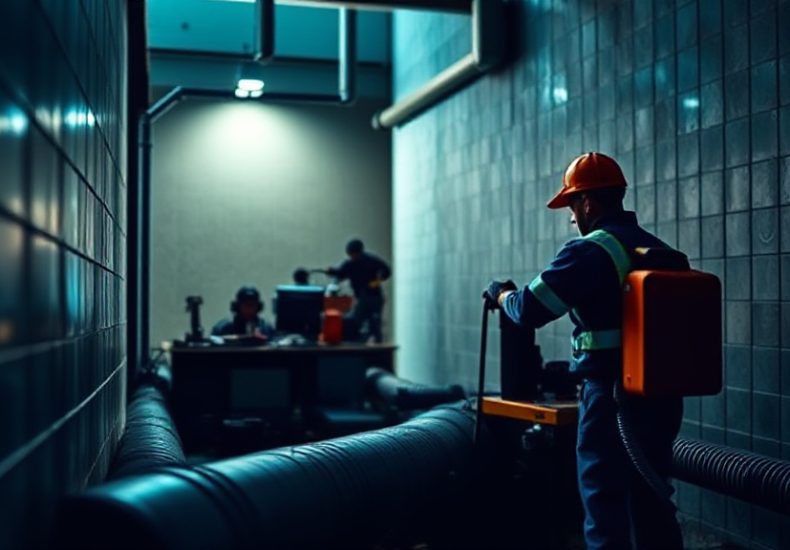
Once the access point is open, the crew chooses between a mechanical auger and high-pressure jetting. A motorized snake is used for short, hard blockages near the fixture — hair, soap residue, paper, small objects. Hydrojetting sends water at controlled pressure through a hose with a backward-facing nozzle, scouring the full diameter of the pipe and pushing debris toward the main line. It is the better choice for grease, sludge, and long runs of pipe.
For a septic tank or a grease trap, the job is not unclogging at all but pumping and cleaning. The team removes the accumulated material, checks the inlet and outlet, and confirms the tank is not returning solids to the drain field. Skipping that step is one of the most common reasons a cleared drain backs up again within weeks.
A walk-through of the visit, in the order it happens
- The crew confirms the problem and protects the floor with covers and buckets.
- The technician opens the nearest clean-out and inspects the flow.
- The blockage is broken up with the auger or flushed with the jetter.
- Water is run at several fixtures to confirm the whole line drains.
- The area is rinsed, and the technician explains what caused the problem.
That last step matters more than most people expect. A crew that leaves without explaining the cause is a crew you will call again soon. A crew that points to the grease, the roots, or the collapsed section gives you something to fix.
What it costs and what changes the price
Pricing for drain work in Colombo depends less on the address and more on three factors: how far the blockage sits from the access point, whether the job needs jetting or just a snake, and whether the pipe must be excavated. A simple sink clear is a short visit. A main-line blockage under a paved driveway, or a septic tank that needs pumping, is a larger job with more equipment and more time.
Emergency calls at night, on weekends, or during heavy rain also carry a higher rate, because the crew is working outside normal hours. Ask for the price before the work begins and confirm whether the fee covers the full clear or only the initial visit.
Mistakes that turn a small blockage into an expensive repair
The most common mistake is pouring chemical drain cleaner into a line that is already fully blocked. The chemical sits against the clog, heats up, and can damage older pipes without clearing anything. Another is plunging a toilet repeatedly while the water level is high, which pushes waste into the overflow and onto the floor.
Homeowners also tend to ignore the warning signs. A drain that gurgles for a week before it stops is telling you the pipe is narrowing. Calling a desentupidora em Colombo PR at the gurgle stage is cheaper than calling after the backup reaches the kitchen floor.
How to keep the line clear after the crew leaves
Prevention is mostly about what goes down the drain. Grease goes in a container, not the sink. Hair goes in a trap or a bin. Paper products that are not designed to break down stay out of the toilet. In homes with mature trees, a periodic jetting of the main line is cheaper than an emergency excavation after roots have cracked a pipe.
For businesses — restaurants, laundries, small food shops — a maintenance schedule matters even more, because a single backup during service hours costs far more than a planned cleaning. A short visit every few months keeps the grease trap and the main line from becoming a weekend emergency.
The lessons worth keeping from a drain emergency
The pattern repeats across Colombo: the problem starts small, gets ignored, and becomes urgent at the worst possible time. The homeowners who come out ahead are the ones who call at the first gurgle, keep the clean-out accessible, and ask the technician what caused the blockage. A good crew will clear the pipe and tell you the truth about why it blocked — and that answer is what keeps your drains flowing long after the van has left.
Leave a Reply